Graham Hancock
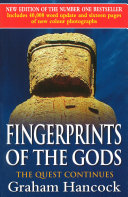
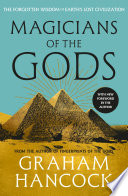
Graham Hancock is a British author and journalist who investigates anomalies in ancient history , proposing that an advanced civilization flourished during the last Ice Age and was obliterated by a global cataclysm approximately 12,800 years ago, with remnants of its knowledge preserved in the monuments and myths of subsequent cultures. Born in Edinburgh , Scotland , Hancock graduated from Durham University in 1973 with first-class honors in sociology before embarking on a career in journalism , contributing to publications such as The Economist , The Times , and The Guardian , and serving as East Africa correspondent for The Economist from 1981 to 1983. Transitioning to authorship in the 1980s, his early works included explorations of historical enigmas like the quest for the Ark of the Covenant in The Sign and the Seal (1992), but he gained international prominence with Fingerprints of the Gods (1995), which marshals evidence from global ancient sites—including astronomical alignments at the Giza pyramids and the precision of the Piri Reis map —to argue for inherited sophistication beyond the capabilities attributed to early humans by conventional timelines. Hancock's later books, such as Underworld (2002), Magicians of the Gods (2015), and America Before (2019), build on this foundation by incorporating underwater ruins, the Göbekli Tepe complex, and Younger Dryas impact hypothesis data to support claims of pre-cataclysm technological prowess and cultural diffusion . These theories, while popularizing alternative prehistory through bestsellers and the Netflix docuseries Ancient Apocalypse (2022), encounter resistance from academic establishments, which prioritize stratigraphic and radiocarbon evidence adhering to gradualist models of development, often sidelining interpretive analyses of mythological and architectural outliers that Hancock emphasizes.
Graham Hancock was born on August 2, 1950, in Edinburgh , Scotland . His early childhood involved relocation to India at around age three or four, following his father's employment as a surgeon in a town near Chennai .
Hancock later returned to England for secondary education in the city of Durham. He pursued higher education at Durham University , where he studied sociology and earned a First Class Honours degree in 1973. This academic background in sociology preceded his entry into journalism .
Hancock pursued a career in journalism following his studies in sociology at Durham University . He initially worked as a freelance journalist , contributing to various British publications, and served as co-editor of the New Internationalist magazine from 1976 to 1979, where he focused on global development and social issues.
In the early 1980s, Hancock took on the role of East Africa correspondent for The Economist from 1981 to 1983, reporting on regional economics, politics, and the impacts of foreign aid. His coverage highlighted the disconnect between international aid policies and their on-the-ground outcomes in countries facing famine , conflict, and underdevelopment, such as Ethiopia during its civil war and drought crises. This period informed his skeptical perspective on institutional aid efforts, which he later expanded in investigative reporting.
Throughout his journalistic tenure, Hancock wrote for leading outlets including The Times , The Sunday Times , The Guardian , and The Independent , producing articles on Third World economics and governance. His work emphasized empirical critiques of aid bureaucracies, drawing on firsthand observations rather than official narratives, though it occasionally strained his financial stability amid freelance demands. By the mid-1980s, these experiences prompted a shift toward book-length investigations, marking the transition from daily reporting to longer-form analysis.