Authors & Guests / Julian Jaynes

Julian Jaynes
Julian Jaynes (February 27, 1920 – November 21, 1997) was an American psychologist and author best known for proposing the bicameral mind hypothesis, which posits that modern human consciousness arose abruptly around 1200 BCE through the breakdown of an earlier mentality in which individuals experienced auditory hallucinations interpreted as commands from gods or authorities.
Jaynes articulated this theory in his seminal 1976 book, The Origin of Consciousness in the Breakdown of the Bicameral Mind , drawing on evidence from ancient texts, archaeology , and neurology to argue that pre-conscious humans operated with a "two-chambered" brain structure where the right hemisphere generated imperative voices and the left interpreted them as external directives, enabling social coordination without introspective self-awareness . The work challenges gradualist evolutionary accounts of mind by emphasizing historical and cultural catalysts, such as the disruptions of the Bronze Age collapse, for the shift to subjective consciousness involving metaphor , analogy , and narrative self-modeling.
Born in West Newton, Massachusetts, Jaynes pursued undergraduate studies at Harvard and McGill universities before earning master's and doctoral degrees in psychology. He lectured in Princeton University's Psychology Department from 1966 to 1990, gaining a reputation as an engaging teacher who often addressed interdisciplinary audiences on topics in consciousness and ancient mentality. Despite the provocative nature of his ideas, which have faced skepticism from neuroscientists favoring innate cognitive modules over learned cultural constructs, Jaynes's framework persists in influencing discussions on schizophrenia , hypnosis , and the roots of religious experience, with renewed interest in recent psychological inquiries.
Julian Jaynes was born on February 27, 1920, in West Newton, Massachusetts, the son of Julian Clifford Jaynes Sr., a Unitarian minister, and Clara Bullard Jaynes.
As a conscientious objector during World War II , Jaynes was initially assigned to a Civilian Public Service camp but refused to comply, viewing it as a continuation of the war effort ; he was arrested after notifying authorities and served three years in the federal penitentiary in Danbury, Connecticut .
Jaynes began his undergraduate studies at Harvard College before transferring to McGill University , from which he received a B.A. in 1941.
He then enrolled at Yale University for graduate work, earning an M.A. in 1948 and a Ph.D. in psychology in 1977.
Jaynes completed his undergraduate studies at Harvard University and McGill University , earning a B.A. from McGill in 1941. He then served as Reader in Psychology at the University of Toronto from 1945 to 1946, followed by roles as Research Assistant , Instructor, and Lecturer at Yale University from 1946 to 1960, where he obtained his M.A. in 1948 and Ph.D. in psychology in 1977. After completing his early graduate work at Yale, Jaynes spent several years in England working as an actor and playwright before returning to academia.
In 1964, Jaynes joined the Psychology Department at Princeton University as a Lecturer and Research Psychologist, a position he held until his retirement in 1995, using Princeton as his primary academic base. During this period, he taught courses on consciousness and maintained affiliations through numerous visiting lectureships and residencies in departments of philosophy, English, archaeology, and medical schools across various institutions. He received honorary degrees, including a Doctor of Humane Letters from Rhode Island College in 1979 and a Doctor of Science from Elizabethtown College in 1985.
Jaynes's research initially focused on comparative psychobiology, examining learning processes and brain functions in organisms ranging from protozoa to cats, including studies on imprinting in birds and neural mechanisms of mating behavior in felines.
Books by Julian Jaynes
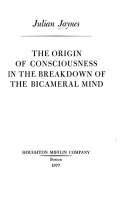
Other works by Julian Jaynes
More books by this author — not yet covered in our podcast catalog.