Authors & Guests / Michael A. Cremo
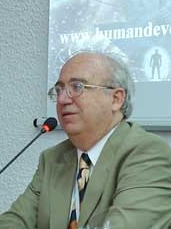
Michael A. Cremo
Michael A. Cremo (born July 15, 1948) is an American author , researcher, and lecturer focused on anomalous evidence in archaeology and alternative theories of human antiquity. Identifying as a Vedic creationist, he examines primary reports of artifacts, bones, and footprints that indicate human-like presence on Earth for millions of years, predating conventional evolutionary timelines. Cremo's seminal work, Forbidden Archeology : The Hidden History of the Human Race (1993), co-authored with Richard L. Thompson , documents over a century of such findings from scientific journals and expeditions, arguing they reveal a systematic filtering of data inconsistent with gradualist Darwinism . The book, published by the Bhaktivedanta Book Trust, spans nearly 1,000 pages in its unabridged edition and has influenced discussions on suppressed evidence in human origins research. Subsequent publications like The Hidden History of the Human Race (condensed edition, 1994) and Human Devolution : A Vedic Alternative to Darwin's Theory (2003) extend his inquiries into spiritual dimensions of evolution and devolution from higher states of consciousness . As a member of the World Archaeological Congress since 1993 and research associate at the Bhaktivedanta Institute, Cremo has presented at academic forums, though his conclusions face rejection from mainstream institutions favoring materialist paradigms over potentially paradigm-shifting anomalies.
Michael A. Cremo was born on July 15, 1948, in Schenectady, New York . His father served as an intelligence officer in the U.S. Air Force, which necessitated frequent relocations and exposed Cremo to various international environments during his childhood, including extended periods in Europe .
Cremo attended high school at an American school in Germany before completing his final year in St. Petersburg, Florida , in 1965, during which he enrolled in a creative writing course that sparked his interest in authorship. The following year, he entered George Washington University on a scholarship to study international affairs, but departed after two years in 1968 to pursue personal exploration of Eastern philosophies. No formal degree was completed at that time.
Michael Cremo, born on July 15, 1948, in the United States, entered the Vedic tradition through the International Society for Krishna Consciousness (ISKCON) in 1973, during a period of personal spiritual exploration influenced by the countercultural movements of the era. He received initiation from ISKCON's founder, A. C. Bhaktivedanta Swami Prabhupada , adopting the devotional name Drutakarma Dasa, which marked his formal commitment to Gaudiya Vaishnava practices centered on devotion to Krishna as described in texts like the Bhagavad Gita and Srimad Bhagavatam .
Following his entry into ISKCON, Cremo immersed himself in Vedic scriptures, which posit cyclical time scales encompassing billions of years and human civilizations predating conventional archaeological timelines by orders of magnitude. This study prompted his initial research into discrepancies between Vedic cosmology and materialist scientific paradigms, particularly Darwinian evolution, leading him to compile historical reports of artifacts suggesting advanced human activity in geological strata dated to the millions of years.
In 1976, Cremo joined the editorial staff of ISKCON's Back to Godhead magazine, where he began publishing articles that juxtaposed Vedic accounts of human origins with purported empirical anomalies overlooked by mainstream archaeology, such as eoliths and out-of-place artifacts embedded in ancient deposits. By 1984, he affiliated with the Bhaktivedanta Institute—ISKCON's branch for scientific inquiry—collaborating with researcher Sadaputa Dasa (Richard L. Thompson) to systematically document and analyze these anomalies, laying the groundwork for later works challenging the uniformitarian assumptions of paleontology.
Books by Michael A. Cremo
Other works by Michael A. Cremo
More books by this author — not yet covered in our podcast catalog.