Authors & Guests / William Peter Blatty
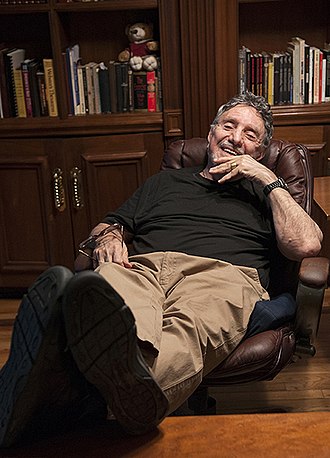
William Peter Blatty
William Peter Blatty (January 7, 1928 – January 12, 2017) was an American novelist, screenwriter, and filmmaker of Lebanese Catholic descent, renowned for his 1971 supernatural horror novel The Exorcist and its 1973 film adaptation, for which he received the Academy Award for Best Adapted Screenplay. Born in Manhattan to immigrant parents amid financial hardship, Blatty attended Jesuit schools including Georgetown University , experiences that shaped his lifelong exploration of faith, evil, and divine providence in his works. His breakthrough novel, inspired by a 1949 exorcism case, became a massive bestseller and cultural phenomenon, topping charts for 17 weeks and grossing over $440 million at the box office , while provoking widespread controversy for its graphic depictions of possession and challenging audiences' views on religion and the supernatural. Blatty's oeuvre extended to other novels such as The Ninth Configuration (1978), which he also directed as a film, and Legion (1983), the basis for The Exorcist III (1990), often weaving Catholic theology with psychological and metaphysical themes to affirm God's existence amid human suffering. A former publicist and game show contestant who rose from obscurity, Blatty's career highlighted his commitment to using fiction as a vehicle for spiritual inquiry, earning praise for revitalizing interest in demonology and exorcism within Catholic circles despite criticisms of sensationalism .
William Peter Blatty was born on January 7, 1928, in New York City to Lebanese immigrant parents, Peter Blatty, a carpenter or cloth cutter by trade, and Mary Mouakad Blatty, a devout Catholic. As the youngest son in the family, Blatty grew up amid severe financial hardship following his parents' separation, with his father abandoning the household when Blatty was a child, leaving his mother to raise the children alone.
The family's poverty was acute, marked by repeated evictions—reportedly 27 or 28 times during Blatty's youth—often forcing them into unstable living situations as his mother struggled to provide through menial labor. These circumstances instilled in Blatty an early awareness of economic precarity, with the household relying on his mother's resourcefulness amid frequent displacements.
Mary Blatty's unshakeable Catholic faith served as the family's anchor, with her dependence on prayer and religious devotion shaping Blatty's formative years despite the absence of paternal support and material scarcity. This reliance on spiritual resilience amid instability profoundly influenced Blatty, embedding a deep-seated Catholicism that contrasted sharply with the surrounding adversities.
Blatty attended Brooklyn Preparatory School , a Jesuit-run high school in Brooklyn , New York, on a full scholarship , graduating as valedictorian in 1946. The institution's curriculum emphasized classical languages, literature, and moral philosophy rooted in Thomistic principles, fostering intellectual discipline and an early engagement with Catholic theology that would underpin his lifelong interest in the interplay between faith and reason.
He continued his Jesuit education at Georgetown University in Washington, D.C. , earning a Bachelor of Arts in English in 1950. There, amid discussions in theology classes and campus lore, Blatty first encountered detailed accounts of authentic exorcism cases, including the 1949 possession and rite performed on a boy in the St. Louis area—events that Jesuit faculty referenced as empirical challenges to materialist skepticism and seeds for his later theological inquiries.
Blatty then obtained a Master of Arts in English literature from the nearby George Washington University in 1954, completing his formal academic training.
Books by William Peter Blatty
Other works by William Peter Blatty
More books by this author — not yet covered in our podcast catalog.