Authors & Guests / Viktor E. Frankl

Viktor E. Frankl
Viktor Emil Frankl (26 March 1905 – 2 September 1997) was an Austrian neurologist, psychiatrist, and Holocaust survivor who founded logotherapy , a school of psychotherapy centered on the human drive to find meaning as the primary motivational force. Born in Vienna to Jewish parents, Frankl demonstrated early academic promise, publishing his first scientific paper at age 18 and engaging with existential questions in psychology influenced by but diverging from Freudian and Adlerian theories.
During World War II , Frankl endured imprisonment in four Nazi concentration camps —Theresienstadt, Auschwitz, Kaufering III, and Türkheim—over a period of three years, during which he lost his parents, brother, and first wife to the regime's atrocities while himself surviving through psychological resilience derived from envisioning postwar purposes, including reconstructing his manuscript on logotherapy destroyed upon arrival at Auschwitz. These experiences informed his seminal 1946 work ... trotzdem Ja zum Leben sagen: Ein Psychologe erlebt das Konzentrationslager (later translated as Man's Search for Meaning ), which has sold over 10 million copies and elucidates how meaning can be discovered even in suffering, contrasting with deterministic views by asserting human freedom to choose attitudes amid uncontrollable circumstances.
Postwar, Frankl resumed his career in Vienna , becoming Professor of Neurology and Psychiatry at the University of Vienna Medical School, authoring 39 books, and lecturing internationally on logotherapy , which posits three avenues to meaning—through work/deeds, experiences/love, and attitude toward unavoidable suffering—gaining recognition as the "Third Viennese School of Psychotherapy." His framework has influenced existential psychology, positive psychology , and therapeutic practices emphasizing purpose over symptom relief, though critiqued by some for insufficient empirical validation compared to behavioral approaches. Frankl's life exemplified causal realism in human behavior , attributing resilience not to innate traits alone but to deliberate meaning-making , as evidenced by his own survival and subsequent contributions to mental health amid ideological upheavals.
Viktor Emil Frankl was born on March 26, 1905, in the Leopoldstadt district of Vienna , Austria , a predominantly Jewish area where he grew up amid everyday manifestations of anti-Semitism. He was the middle child of three siblings in a middle-class Jewish family.
His father, Gabriel Frankl, originated from Southern Moravia and advanced from a modest position to become a director in the Austrian Ministry of Social Services, embodying disciplined ambition in a civil service career. Gabriel's professional stability provided the family with a reliable economic foundation during the pre-World War I era in the Austro-Hungarian Empire .
Frankl's mother, Elsa (née Lion ), hailed from Prague and was known for her kindhearted and deeply pious nature, reflecting traditional Jewish values that influenced the household environment. Despite occasional familial tensions, such as her viewing young Viktor as troublesome, the parents' backgrounds from distinct regions of the empire— Moravia and Bohemia —contributed to a culturally layered upbringing in Vienna's assimilated Jewish community.
Viktor Frankl grew up in Vienna 's Leopoldstadt district, a predominantly Jewish area where he witnessed routine anti-Semitism during his formative years in the early 20th century . As the middle child in a modest Jewish family—his father a civil servant in the Ministry of Social Service and his mother originating from Prague —he navigated the cultural and social tensions of the Austro-Hungarian Empire's dissolution and the ensuing interwar period .
Books by Viktor E. Frankl
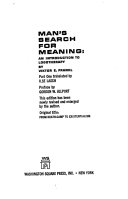
Other works by Viktor E. Frankl
More books by this author — not yet covered in our podcast catalog.