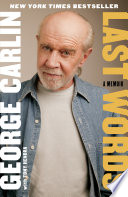
Authors & Guests / George Carlin

George Carlin
George Denis Patrick Carlin (May 12, 1937 – June 22, 2008) was an American stand-up comedian, actor, author, and social critic whose career spanned over five decades, marked by incisive satire targeting language , religion, politics, and cultural hypocrisies. Beginning in radio while serving in the U.S. Air Force in 1956, Carlin transitioned to stand-up comedy , gaining prominence through appearances on The Tonight Show and as the host of the inaugural episode of Saturday Night Live in 1975.
His 1972 routine "Seven Words You Can Never Say on Television," a profane enumeration of taboo terms, led to obscenity complaints when broadcast on radio, culminating in the 1978 Supreme Court case FCC v. Pacifica Foundation , which affirmed the Federal Communications Commission's regulatory power over indecent content during certain hours. Carlin produced 14 HBO comedy specials, won five Grammy Awards for his spoken-word albums, and authored best-selling books such as Brain Droppings (1997), earning the Mark Twain Prize for American Humor in 2008 shortly before his death from heart failure .
Carlin's work evolved from clean-cut humor in the 1960s to darker, more philosophical critiques, often emphasizing individual responsibility over institutional reliance and mocking euphemistic language as a tool for obfuscation . His routines challenged societal norms without deference to prevailing sensitivities, positioning him as a countercultural figure who influenced generations of comedians through unfiltered observation of human folly and governmental overreach.
George Denis Patrick Carlin was born on May 12, 1937, at New York Hospital in Manhattan, New York City. He was the younger son of Patrick John Carlin, an advertising manager for The Sun originally from County Donegal, Ireland, and Mary (née Bearey) Carlin, a secretary of Irish-American descent. His parents separated when he was two months old, leaving his father largely absent from his life; Patrick Carlin died in 1945 when George was eight years old. Carlin and his older brother, Patrick Jr., were raised primarily by their mother in a working-class household marked by financial instability and emotional neglect, as Mary Carlin worked long hours to support the family amid poverty in Manhattan's Morningside Heights neighborhood.
The family environment was turbulent, with reports of domestic violence from the father toward the mother and older brother before the separation, contributing to an unstable home life that Carlin later described as fostering his early sense of alienation. Raised in a devout Irish Catholic milieu, Carlin attended Catholic schools, including the Salesian High School and later Cardinal Hayes High School in the Bronx , but exhibited early rebellious tendencies through truancy and defiance of authority . He was expelled from Cardinal Hayes after three semesters at age 15 for disciplinary issues, including stealing from school events, and ultimately dropped out of high school without graduating. These experiences of neglect , poverty , and repeated clashes with institutional authority instilled in Carlin an anti-authoritarian streak rooted in personal hardship rather than abstract ideology .
Amid this backdrop, Carlin found early solace in radio broadcasts, which exposed him to comedy pioneers like Jack Benny , whose timing and wordplay captivated him during his formative years in a radio-saturated household. This medium, accessible despite the family's modest means, sparked his interest in performance and linguistic play, contrasting with the rigid Catholic education and familial constraints that otherwise dominated his childhood.
Carlin enlisted in the United States Air Force in 1954 at age 17, shortly after dropping out of high school, and underwent training as a radar technician before being stationed at Barksdale Air Force Base in Bossier City, Louisiana , near Shreveport.