Podcasts / The Joe Rogan Experience / JRE MMA Show #17 with Yoel Romero & Joey Diaz
JRE MMA Show #17 with Yoel Romero & Joey Diaz
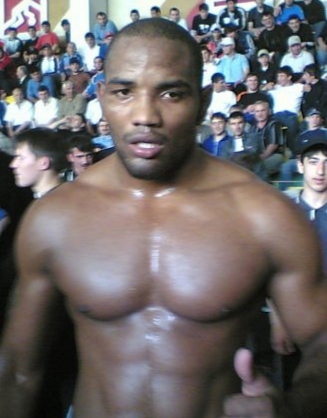
Yoel Romero Palacio (born April 30, 1977) is a Cuban -born American mixed martial artist , bare-knuckle boxer, and former freestyle wrestler who represented Cuba in international competition before defecting to pursue opportunities in the United States. As a wrestler, he achieved elite success, capturing the gold medal at the 1999 World Wrestling Championships in the 85 kg freestyle division and earning silver at the 2000 Summer Olympics in Sydney , along with four additional world championship medals across five appearances. After defecting in 2007 following a tournament in Germany , Romero transitioned to mixed martial arts in his mid-30s, debuting professionally in 2011 and joining the UFC middleweight division in 2013, where his explosive athleticism and knockout power led to an 8-fight unbeaten streak and two title challenges against Robert Whittaker and Israel Adesanya . Compiling a 16-7 MMA record with 13 knockouts, he continued competing post-UFC in Bellator and PFL before signing with Bare Knuckle Fighting Championship in 2025 and securing a dominant debut victory over Theo Doukas on September 12. Known as the Soldier of God for his devout Christian faith and nicknamed for his relentless style, Romero has maintained remarkable physical prowess into his late 40s, defying typical age-related decline in combat sports through rigorous training and genetic advantages in strength and explosiveness. Yoel Romero Palacio was born on April 30, 1977, in Pinar del Río, Cuba, a rural province known for its tobacco production amid widespread economic hardship under the communist government. He grew up in a family with a tradition of involvement in combat sports, instilling early values of discipline and resilience, though no relatives achieved notable success in athletics. The socio-economic constraints of 1980s and 1990s Cuba, including rationed food and limited opportunities, shaped a formative environment marked by scarcity that Romero later described as evoking both hardship and personal fortitude. From a young age, Romero was exposed to freestyle wrestling through Cuba's state-supported sports system, beginning training in the 1990s at local facilities in Pinar del Río . This early involvement highlighted his innate physical attributes, such as explosive strength and agility, which propelled him toward competitive success. Family emphasis on perseverance amid Cuba's collectivist culture further reinforced a mindset geared toward athletic excellence as a path to distinction. As a youth, Romero achieved initial triumphs at the national level in freestyle wrestling , competing in junior categories under the Cuban federation before transitioning to senior events. His promising performances in age-group competitions demonstrated rapid development, setting the foundation for international representation and underscoring how Cuba's rigorous training regimens, despite material limitations, cultivated his technical skills and mental toughness . In 2007, during an international freestyle wrestling tournament in Germany, Yoel Romero defected from Cuba by electing to remain in the host country rather than rejoin the Cuban national team for the return flight. This act severed his ties to the Cuban regime, which tightly controls athletes' international travel and imposes penalties on deserters, including potential imprisonment or surveillance of family members left behind. Romero's decision was motivated by "problems" that arose in Cuba, compounded by the pursuit of expanded opportunities for himself and his family—such as higher earnings and professional autonomy—unattainable under the state's centralized sports system, where even Olympic-level performers receive minimal compensation beyond basic stipends.

Joey "CoCo" Diaz (born José Antonio Díaz; February 19, 1963) is a Cuban-American stand-up comedian, actor , podcaster, and author renowned for his raw, autobiographical storytelling style that draws from his tumultuous life experiences. Born in Havana , Cuba , he immigrated to the United States at age three and was raised in North Bergen, New Jersey, where he navigated a challenging upbringing marked by family loss and legal troubles, including a period of incarceration in the late 1980s . Diaz began his comedy career in 1988 while serving time in a Denver correctional facility, where he performed stand-up routines during movie breaks to entertain fellow inmates, eventually transitioning to professional stages after his release. His breakthrough in acting came with supporting roles in major films, including Spider-Man 2 (2004), The Longest Yard (2005), Taxi (2004), Grudge Match (2013) alongside Sylvester Stallone and Robert De Niro, and The Many Saints of Newark (2021) as Buddha Bonpensiero in the Sopranos prequel. On television, he has appeared in series such as My Name Is Earl , The Mentalist , Eastbound & Down , Children's Hospital , and General Hospital , often playing characters that leverage his distinctive gravelly voice and intense persona. Diaz released his first one-hour stand-up special, Sociably Unacceptable , in 2016, and his comedy has been featured on platforms like This Is Not Happening . As a podcaster, Diaz has built a massive following through unfiltered discussions of personal anecdotes, addiction recovery, and life lessons; he co-hosted The Church of What's Happening Now from 2012 to 2016, revived it as The New Testament in 2024, and currently hosts Uncle Joey's Joint and The Check-In with co-host Lee Syatt. He is a frequent guest on The Joe Rogan Experience , appearing over 40 times since 2009, which has amplified his cult status in comedy circles. In 2022, Diaz published his memoir Tremendous: The Life of a Comedy Savage , a New York Times bestseller that chronicles his path from street crime and substance abuse to sobriety and stardom. Married to Terrie Clark since 2007, he is a father and continues touring with shows like his 2026 performance 62 & Still Slinging at Seminole Hard Rock Tampa. José Antonio Díaz was born on February 19, 1963, in Havana , Cuba , to a Cuban father and a mother of Spanish descent. His father died when he was three years old, leaving the family in difficult circumstances under the early years of the Castro regime. At the age of three, in 1966, Díaz immigrated to the United States with his mother, initially settling on the Upper West Side of Manhattan , New York City . The family later relocated to North Bergen, New Jersey , where Díaz spent much of his formative years. Díaz was raised in a strict Catholic household by his single mother, who worked as a hairdresser and later owned and operated a bar along with a numbers racket to support the family. His upbringing was marked by a blend of Cuban cultural traditions and the challenges of adapting to American life in a working-class neighborhood. He attended McKinley School and North Bergen High School , where he began navigating the cultural shifts of his new environment, including exposure to diverse influences from school peers and the local community. Early on, Díaz took on odd jobs such as working as a dishwasher and a delivery boy to contribute to the household . In 1979, when Díaz was 16, his mother died of a heart attack, an event that plunged him into profound emotional turmoil. Following her death, he lived with relatives while grappling with the loss and the instability it brought to his life. This period of grief and upheaval profoundly shaped his early worldview, highlighting the hardships of his immigrant roots and family dynamics. Following the death of his mother at age 16, Diaz dropped out of high school and descended into a period of escalating personal troubles in New Jersey.
About this episode
Joe sits down with Yoel Romero to discuss his history as a fighter and wrestler from Cuba, and Joey Diaz joins to assist with translation from Spanish.
Reviews
Sign in to write a review.