Authors & Guests / Willis Barnstone
Willis Barnstone
Willis Barnstone (born November 13, 1927, in Lewiston, Maine) is an American poet, translator, religious scholar, and Distinguished Professor Emeritus of Comparative Literature and Spanish at Indiana University. He is renowned for his prolific output of poetry, literary criticism, and translations from languages including ancient Greek, Spanish, French, Chinese, and biblical Hebrew, with notable renderings of poets such as Sappho, Antonio Machado, Jorge Luis Borges, Rainer Maria Rilke, and Wang Wei, as well as complete translations of the New Testament (titled The Restored New Testament or New Covenant ) and Gnostic writings.
Born in Lewiston, Maine, Barnstone earned his B.A. from Bowdoin College in 1948, his M.A. from Columbia University in 1956, and his Ph.D. from Yale University in 1960, with additional studies at the University of Mexico, the Sorbonne, and the University of London. His academic career has included teaching positions at Wesleyan University, Colgate University (where he served as O’Connor Professor of Greek), and Indiana University, alongside international experiences such as teaching in Greece at the end of its civil war, in Argentina during the Dirty War, and as a Fulbright Professor at Beijing Foreign Studies University in 1984–1985.
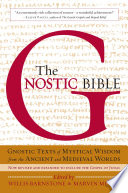
Barnstone is the author of more than seventy books, including poetry collections such as From This White Island (1960), The Secret Reader: 501 Sonnets (1996), Life Watch (2003), and Mexico in My Heart: New & Selected Poems (2015); critical works including The Poetics of Translation: History, Theory, Practice (1993); and memoirs such as With Borges on an Ordinary Evening in Buenos Aires (1993), reflecting his close friendship with Jorge Luis Borges. His translations and religious scholarship encompass works like The Gnostic Bible , Poets of the Bible , and The Poems of Jesus Christ .
He has received numerous honors, including a Guggenheim Fellowship, grants from the National Endowment for the Arts and National Endowment for the Humanities, the W. H. Auden Award from the New York State Council on the Arts , the Emily Dickinson Award from the Poetry Society of America, and multiple Pulitzer Prize nominations. Barnstone frequently reads with his children, the poets Aliki Barnstone and Tony Barnstone, and resides in Oakland, California.
Willis Barnstone was born on November 13, 1927, in Lewiston, Maine. His family was Jewish, and the surname had been changed from Bornstein to Barnstone around 1917 to escape antisemitism.
He grew up in New York City, where his family lived on Riverside Drive. As a child, he played stickball on 89th Street in Manhattan.
One notable childhood memory occurred in spring 1939, when, at age 11, Barnstone met Babe Ruth in their apartment building on Riverside Drive. He was in his Boy Scout uniform for the occasion, as Ruth was participating in the 1939 New York World’s Fair by giving out diplomas from a fictitious Academy of Sports. A photograph of Barnstone with Ruth and another boy appeared on the front page of the New York Daily News on May 1, 1939. In a later interview, Barnstone recalled Ruth fondly, describing him as "the immortal Babe" who "never forgot that he was an orphan" and was "the opposite of a racist."
Willis Barnstone earned his Bachelor of Arts degree cum laude from Bowdoin College in 1948. He pursued additional studies at the University of Mexico, the Sorbonne in Paris, and the School of Oriental and African Studies at the University of London.
During the immediate postwar period, Barnstone taught at the Anavryta Classical Lyceum in Greece from 1949 to 1950, toward the end of the Greek Civil War.
He later completed his Master of Arts degree at Columbia University in 1956 and his Doctor of Philosophy degree at Yale University in 1960. These diverse educational experiences across Europe, Latin America, and the United States built a multilingual foundation that shaped his subsequent work in comparative literature and translation.
Books by Willis Barnstone
Other works by Willis Barnstone
More books by this author — not yet covered in our podcast catalog.