Authors & Guests / Steven Pinker

Steven Pinker
Steven Pinker is a Canadian-American experimental psychologist, psycholinguist, and author specializing in visual cognition, language acquisition, and the evolutionary underpinnings of human behavior and social relations. He serves as the Johnstone Family Professor of Psychology at Harvard University, where his work integrates computational models with empirical data to explain mental processes and historical trends in violence.
Pinker has authored influential books such as The Language Instinct (1994), which argues that language is an innate human faculty shaped by evolution ; The Blank Slate (2002), critiquing the notion of the mind as a tabula rasa devoid of innate content; and The Better Angels of Our Nature (2011), presenting statistical evidence for a long-term decline in human violence driven by institutions of reason and self-control . These works have earned him recognition including prizes from the National Academy of Sciences , the American Psychological Association , and the Association for Psychological Science, as well as honorary doctorates from multiple universities. His research emphasizes data-driven analysis over ideological priors, challenging blank-slate environmentalism and documenting measurable human progress through science and humanism .
Pinker's advocacy for Enlightenment principles—reason, empiricism, and humanism—has positioned him as a public intellectual defending liberal values against relativism and declinism, though it has drawn criticism from academics and activists who accuse him of understating systemic inequalities or endorsing hereditarian views on traits like intelligence and behavior. These controversies, often amplified in left-leaning academic circles, include efforts to remove him from professional roles despite his empirical focus, highlighting tensions between data-centric scholarship and prevailing institutional orthodoxies. Despite such pushback, his contributions underscore causal mechanisms in cognition and societal improvement, grounded in longitudinal datasets rather than anecdotal narratives.
Steven Pinker was born on September 18, 1954, in Montreal , Quebec , Canada , into a middle-class, secular Jewish family within the city's English-speaking community . His parents, Harry and Roslyn Pinker, provided a stable household that emphasized education and intellectual engagement without religious orthodoxy, reflecting the secular orientation of many urban Jewish families in mid-20th-century Canada .
Harry Pinker worked primarily in sales, having trained as a lawyer but not practicing until later in life, which exposed young Steven to practical problem-solving and resilience in professional settings. Roslyn Pinker, initially a homemaker, later pursued roles as a high school guidance counselor and vice-principal at Bialik High School in Montreal , modeling analytical approaches to language and student development that aligned with empirical evaluation of individual potential. This parental emphasis on education encouraged Pinker to pursue academic excellence from an early age.
The family environment featured frequent discussions characterized by debate and argumentation, typical of the English-speaking Jewish community in Montreal , which Pinker later described as fostering a habit of questioning unsubstantiated assertions. Such dynamics promoted skepticism toward dogma , including religious claims, prioritizing evidence-based reasoning over tradition in everyday discourse. This cultural milieu, combined with a stable socioeconomic backdrop free of acute hardship, enabled Pinker's early intellectual pursuits without the distractions of instability, laying groundwork for his later focus on cognitive mechanisms and rational inquiry.
Steven Pinker earned a Bachelor of Arts degree with first-class honors in experimental psychology from McGill University in 1976.
Episodes
Books by Steven Pinker


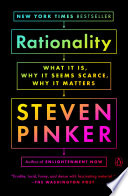

Other works by Steven Pinker
More books by this author — not yet covered in our podcast catalog.