Authors & Guests / Richard Marcinko
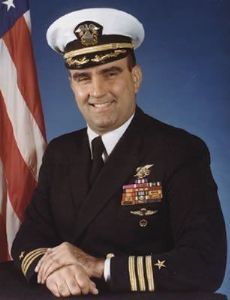
Richard Marcinko
Richard Marcinko (November 21, 1940 – December 25, 2021) was a United States Navy captain and SEAL officer who founded and first commanded SEAL Team Six, the service's premier counter-terrorism unit established after the 1979 Iran hostage crisis to address deficiencies exposed in operations like the failed Eagle Claw rescue. A two-tour Vietnam War combat veteran of Slovak descent from a Pennsylvania mining town, he enlisted in 1958, earned a commission in 1965, and received the Silver Star, four Bronze Stars with "V" device for valor, two Navy Commendation Medals, and the Vietnamese Cross of Gallantry during riverine and SEAL platoon operations.
Marcinko's unconventional leadership emphasized aggressive training and real-world testing of defenses, leading him to command SEAL Team Two before creating SEAL Team Six in 1980 and later the Red Cell unit in 1984, tasked with infiltrating naval bases to reveal vulnerabilities in security protocols. These innovations enhanced special operations capabilities but drew criticism for flouting regulations on discipline, equipment procurement, and operational norms. His Navy career ended in 1989 amid indictment for procurement fraud ; convicted in 1990 of conspiracy to defraud the government over grenade contracts, he served 21 months in federal prison and was fined $10,000.
Post-retirement, Marcinko authored the 1992 bestseller Rogue Warrior , a memoir detailing his exploits that spawned a series and video game adaptations, while working as a consultant and speaker, though his self-promoted "Demo Dick" persona and admissions of bending rules underscored a legacy blending tactical brilliance with ethical lapses.
Richard Marcinko was born on November 21, 1940, in Lansford, Pennsylvania , a small coal-mining town plagued by economic hardship, to George L. Marcinko, a coal miner, and Emilie Teresa Pavlik Marcinko, immigrants from Slovakia . His family's Slovak heritage and working-class roots exposed him to the rigors of industrial labor and community resilience amid frequent strikes and limited opportunities in the anthracite region.
At a young age, the Marcinkos relocated to New Brunswick, New Jersey , where they navigated urban poverty, housing projects, and blue-collar environments that demanded self-reliance. In his 1992 autobiography Rogue Warrior , co-authored with John Weisman, Marcinko recounted a childhood marked by street fights, barroom exposure, and manual labor, which cultivated physical toughness and an instinctive wariness of institutional authority from observing his father's struggles in unionized mines. These experiences, devoid of formal structure, emphasized practical survival over deference, shaping a drive for independence without romanticized narratives of destiny. By age seventeen, disillusioned with high school, he dropped out, reflecting the era's limited paths for immigrant descendants in such settings.
Richard Marcinko enlisted in the United States Navy on September 19, 1958, at the age of 17, initially serving as a radioman. His early enlisted service involved communications duties, during which he demonstrated leadership qualities that facilitated rapid advancement through the non-commissioned ranks prior to pursuing specialized training.
In 1963, Marcinko entered Underwater Demolition Team Replacement (UDTR) training, graduating from Class 26 in October of that year. This program, a precursor to modern SEAL Basic Underwater Demolition /SEAL (BUD/S) training, imposed extreme physical and psychological stresses, including prolonged exposure to cold water, sleep deprivation , and high-risk evolutions such as beach reconnaissance swims and demolition exercises, resulting in attrition rates exceeding 75% for most classes. Marcinko's perseverance through these demands highlighted his resilience, earning him assignment to Underwater Demolition Team 21 (UDT-21).
Books by Richard Marcinko
Other works by Richard Marcinko
More books by this author — not yet covered in our podcast catalog.