Authors & Guests / René Descartes
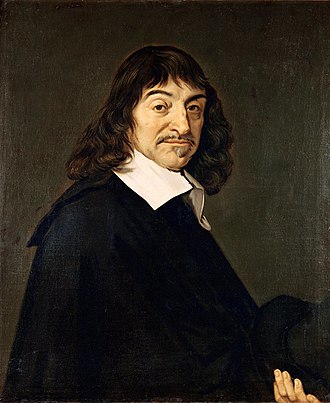
René Descartes
René Descartes (1596–1650) was a French philosopher, mathematician , and natural philosopher renowned for initiating modern philosophy's turn toward rationalism and foundational epistemology . He famously articulated the indubitable proposition cogito ergo sum ("I think, therefore I am") as the bedrock of certain knowledge amid radical doubt, rejecting reliance on sensory deception or unexamined traditions in favor of clear and distinct ideas derived from reason.
Descartes advanced mathematics by inventing analytic geometry in his 1637 appendix La Géométrie , which unified algebra and geometry through the Cartesian coordinate system , enabling the representation of geometric curves via equations and paving the way for calculus . In natural philosophy, he proposed a mechanistic worldview where bodies operate as extended substances governed by laws of motion, excluding purpose or final causes, though his specific hypotheses like vortex cosmology were later empirically falsified.
His advocacy of mind-body dualism posited res cogitans (thinking substance) as ontologically distinct from res extensa (extended substance), influencing debates on consciousness and materialism but inviting critiques for failing to causally bridge the immaterial and material realms. Despite efforts to align his system with Catholic doctrine, works like Meditations on First Philosophy (1641) faced ecclesiastical scrutiny, reflecting tensions between innovative inquiry and institutional authority. Reluctantly summoned to tutor Queen Christina in Stockholm's harsh winters, Descartes succumbed to pneumonia on 11 February 1650.
René Descartes was born on March 31, 1596, in La Haye en Touraine (now Descartes), in the Touraine region of France , at the home of his maternal grandmother. His father, Joachim Descartes, served as a councillor in the Parlement of Brittany at Rennes , while his mother, Jeanne Brochard, died of tuberculosis in May 1597, when Descartes was just over a year old. Following her death, Descartes and his siblings—brother Pierre and sister Jeanne—were raised primarily by their maternal grandmother, Jeanne Sain Brochard, and a great-uncle in La Haye, as their father was frequently absent due to professional duties in Rennes .
Descartes experienced frequent illnesses during his early childhood, which reportedly led to a regimen of extended morning bed rest prescribed by his teachers later in life, a habit he maintained into adulthood.
In 1606 or 1607, at around age ten or eleven, Descartes entered the Jesuit Collège de La Flèche in Anjou, one of the most prestigious schools in Europe at the time, recently founded in 1604. He remained there as a boarder until 1614 or 1615, receiving a comprehensive education in the humanities , including grammar , rhetoric , and poetry in Latin and Greek; natural philosophy following the Scholastic-Aristotelian tradition; and mathematics , which the Jesuits particularly emphasized through figures like Jean François. This curriculum instilled in him both admiration for the deductive certainty of mathematics and dissatisfaction with the speculative nature of Scholastic philosophy.
After La Flèche , Descartes studied law at the University of Poitiers from approximately 1614 to 1616, earning a baccalaureate and then a license in canon and civil law to fulfill his father's expectations, though he never practiced law .
Upon completing his education at the Jesuit College of La Flèche in 1614 and a brief period of legal studies in Poitiers , Descartes, at age 22, enlisted as a volunteer in the Dutch States Army under Prince Maurice of Nassau in Breda , Netherlands , in the summer of 1618. This peacetime service, which lasted approximately 15 months without pay, allowed him to study mathematics under Simon Stevin's disciple Jacob Golius and military engineering , reflecting his interest in practical applications of geometry .
Books by René Descartes

Other works by René Descartes
More books by this author — not yet covered in our podcast catalog.