Authors & Guests / Miyamoto Musashi

Miyamoto Musashi
Miyamoto Musashi (c. 1584–1645) was a Japanese ronin, swordsman, philosopher, writer , and artist who lived during the transition from the Sengoku period to the early Edo period , widely regarded as one of history's greatest duelists for his undefeated record in over 60 duels and his development of innovative martial techniques.
He founded the Niten Ichi-ryū school of kenjutsu , a two-sword fighting style that utilized both a katana and wakizashi simultaneously to enhance combat versatility.
Born c. 1584, possibly in Harima or Mimasaka Province , to a family of samurai retainers, Musashi's early life was marked by hardship, including the early death of his mother and abandonment by his father, leading him to be raised by relatives. He began training in swordsmanship as a youth and fought his first duel at age 13, killing an opponent, before participating in major conflicts such as the Battle of Sekigahara in 1600 on the losing Western Army side. By age 29, he had engaged in more than 60 life-or-death duels without defeat, often using a wooden bokken in later years to minimize lethality while demonstrating superior skill. One of his most famous victories was against the swordsman Sasaki Kojirō in 1612 on Ganryū Island, where he arrived late and used a carved boat oar as a weapon.
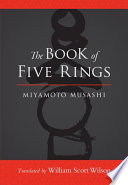
In his later years, Musashi shifted focus from combat to intellectual and artistic pursuits, traveling Japan to teach and refine his philosophy . He authored The Book of Five Rings ( Go Rin No Sho ) in 1645 while secluded in the Reigandō cave on Mount Iwato, a treatise on strategy , martial arts , and Zen-influenced tactics divided into five "elements" that continues to influence modern disciplines like business and sports. Shortly before his death on June 13, 1645, he also wrote Dokkōdō ( The Path of Aloneness ), a set of 21 precepts emphasizing self-reliance , discipline , and detachment. As an artist, Musashi produced ink paintings and calligraphy that blended martial themes with Zen aesthetics, such as his depiction of a shrike bird perched on a dead branch, symbolizing resilience.
Miyamoto Musashi, originally named Shinmen Bennosuke or possibly Takezō, was born in 1584 in the village of Miyamoto, located in the Yoshino district of Mimasaka Province (modern-day Okayama Prefecture ), though some historical accounts place his birth in neighboring Harima Province (modern-day Hyōgo Prefecture ). The exact date and location remain uncertain due to limited contemporary records, with scholars debating details based on later biographies and clan documents.
Musashi's father, Shinmen Munisai (also known as Hirata Munisai), was a prominent rōnin and skilled martial artist renowned for his expertise in jittejutsu (the art of the iron truncheon) and yarimani ( spear techniques), serving as a retainer to the Shinmen clan under lords like Ukita Hideie . His mother is less documented, with some accounts identifying her as Omasa, a sister of Shinmen Munetsura, though others suggest she may have died early or that parental separation led to Musashi's upbringing by relatives. Following family circumstances, including possible discord or his mother's death, Musashi was raised primarily by his uncle , a Buddhist monk named Dorin at the Shoreian Temple, who provided early guidance amid the clan's samurai traditions.
The Shinmen family, to which Musashi was born, held a modest domain of about 5,000 koku and included around 60 samurai retainers by the 1580s, reflecting their status as local warriors in a turbulent era. Musashi later adopted the surname "Miyamoto" from his birthplace village, signifying his integration into that lineage while retaining ties to the Shinmen heritage. Born in the waning years of Japan's Sengoku period (1467–1603), a time of relentless civil wars and shifting alliances among daimyo , Musashi's early life was shaped by an environment of constant violence and martial necessity, which normalized exposure to combat from a young age.
Books by Miyamoto Musashi
Other works by Miyamoto Musashi
More books by this author — not yet covered in our podcast catalog.