Authors & Guests / Milton Friedman

Milton Friedman
Milton Friedman (July 31, 1912 – November 16, 2006) was an American economist, statistician, and public intellectual renowned for his empirical analyses of monetary policy and advocacy of free-market principles. Born in Brooklyn, New York , to Jewish immigrant parents, Friedman rose through academic ranks to become a professor at the University of Chicago , where he helped revitalize the Chicago School of economics emphasizing rigorous empirical testing and skepticism toward expansive government intervention.
Friedman's most enduring contribution was founding monetarism , the theory that variations in the money supply are the primary driver of economic fluctuations, challenging Keynesian dominance by demonstrating through historical data—such as his co-authored work on the Great Depression —that central bank errors exacerbated downturns rather than fiscal stimuli resolving them. In 1976, he received the Nobel Memorial Prize in Economic Sciences for advancements in consumption function analysis, monetary history and theory, and explorations of economic stabilization policy complexity. His ideas influenced global policy shifts, including disinflation strategies under leaders like Paul Volcker and market-oriented reforms in countries facing hyperinflation , underscoring the causal primacy of steady monetary growth over discretionary interventions.
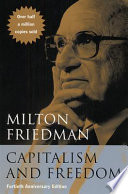
Beyond academia, Friedman applied first-principles reasoning to public policy, proposing innovations like a negative income tax to replace welfare bureaucracies with direct cash transfers, vouchers for school choice to foster competition in education, and the all-volunteer military, which he advised President Nixon to implement, ending U.S. conscription in 1973 and improving force quality through market incentives. His popular book Capitalism and Freedom (1962) and PBS series Free to Choose (1980) disseminated these views to broad audiences, arguing that economic liberty underpins personal freedom and prosperity, though his advisory role in Chile's post-Allende reforms drew criticism amid that regime's political repression—critiques often overlooking the empirical success in curbing inflation and spurring growth via deregulation and privatization. Friedman's legacy endures in debates over central banking independence, fiscal restraint, and the limits of state power, validated by subsequent economic episodes affirming monetarist predictions over alternative paradigms.
Milton Friedman was born on July 31, 1912, in Brooklyn , New York, as the fourth and youngest child—and only son—of Jewish immigrants Sára Ethel Landau and Jenő Saul Friedman. His parents originated from Carpatho-Ruthenia, a region then part of the Austria-Hungary empire (later Czechoslovakia and incorporated into the Soviet Union by the time of Friedman's autobiographical account). The family, consisting of Friedman and his three older sisters, relocated to Rahway, New Jersey —a small town approximately 20 miles from New York City —when he was one year old.
In Rahway, Friedman's mother managed a modest retail dry goods store, while his father worked as a salesman for a larger dry goods wholesaler, sustaining the family in working-class circumstances marked by poverty but sufficient provision through maternal thrift and paternal earnings. The household operated within a Jewish immigrant milieu amid a predominantly Anglo-Protestant community, where Friedman attended public schools and developed as an avid reader and academically gifted student. His father's death in 1927, during Friedman's senior year of high school, imposed financial strains that Friedman and his surviving sisters helped alleviate by supporting their mother. This early experience of self-reliance and economic precarity, amid the stability of a traditional family structure, shaped his formative years without evident privation of basic needs .
Books by Milton Friedman
Other works by Milton Friedman
More books by this author — not yet covered in our podcast catalog.