Authors & Guests / Max Weinreich

Max Weinreich
Max Weinreich (1894–1969) was a Latvian-born American Yiddish linguist, philologist, and scholar who co-founded the YIVO Institute for Jewish Research in 1925 and directed its scholarly activities, pioneering systematic studies of Yiddish as a distinct language with its own grammar, dialectology , and cultural influences.
Born in Kuldiga, Latvia , Weinreich began publishing in Yiddish at age 13 and pursued higher education at universities in St. Petersburg and Berlin before earning a doctorate from the University of Marburg in 1923 with a thesis on the history of Yiddish linguistic research . In Vilna (now Vilnius ), he helped establish YIVO as a center for Jewish scholarship, initially housing its offices in his apartment, and contributed to fields beyond linguistics , including translations of Sigmund Freud into Yiddish and analyses of Jewish sociology and psychology.
Fleeing Nazi persecution, Weinreich immigrated to the United States in 1940 and reestablished YIVO in New York, where he became the first university professor of Yiddish at the College of the City of New York and Columbia University , training a generation of scholars. His magnum opus, Geshikhte fun der yidisher shprakh (History of the Yiddish Language), a four-volume work completed shortly before his death and published in 1973, remains the comprehensive scholarly account of Yiddish's evolution, integrity, and versatility as a fusion of Hebrew, Germanic, Slavic, and Romance elements. Through such efforts, he elevated Yiddish from folk dialect to object of rigorous academic inquiry, developing theoretical frameworks for sociolinguistic analysis applicable to other Jewish languages .
Max Weinreich was born on April 22, 1894, in Kuldiga (German: Goldingen), a town in the Courland Governorate of the Russian Empire (present-day Latvia ), into a middle-class Jewish merchant family . He was the youngest of ten children in a household where German served as the primary language, reflecting the cultural influences of Baltic German-Jewish communities in the region.
Weinreich's early years unfolded amid the multi-ethnic dynamics of Courland , where Litvak Jewish culture intersected with German and Russian elements, though his family's German-oriented milieu initially distanced him from the Yiddish spoken by many local Jews . As a child, he received education primarily in Russian and German, demonstrating early aptitude in these languages, but it was not until his teenage years that he encountered and became intrigued by Yiddish through interactions with peers. This linguistic shift occurred against the backdrop of revolutionary stirrings in the empire, including exposure to socialist ideas and clandestine activities among Jewish youth.
The pervasive anti-Semitism of the Tsarist era, exemplified by restrictions on Jewish residence and periodic violence following the 1905 Revolution, marked the broader context of Weinreich's formative environment, though specific personal encounters with pogroms in Courland —less intense than in southern regions—are not documented in primary accounts. These conditions nonetheless contributed to a heightened awareness of Jewish vulnerabilities, fostering in young Weinreich an eventual commitment to cultural documentation amid assimilation pressures.
Max Weinreich began his higher education at the University of St. Petersburg in 1912, studying amid the disruptions of World War I and the Russian Revolution , which he navigated until 1918 . Following this, he continued his studies at the University of Berlin from 1918 to 1920 , immersing himself in the German academic environment conducive to philological and linguistic inquiry.
Weinreich then pursued graduate work in linguistics at the University of Marburg, completing his doctorate in 1923 with a dissertation titled Studien zur Geschichte und dialektischen Gliederung der jiddischen Sprache (Studies on the History and Dialectal Division of the Yiddish Language).
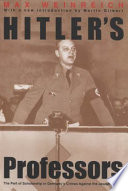
Books by Max Weinreich
Other works by Max Weinreich
More books by this author — not yet covered in our podcast catalog.