Authors & Guests / Leo Perutz
Leo Perutz
Leo Perutz (1882–1957) was an Austrian-Jewish novelist, dramatist, and mathematician renowned for blending historical fiction with mystery, irony, and supernatural elements in his concise, intricately plotted narratives.
Born on November 2, 1882, in Prague to a nonreligious, upper-middle-class Jewish family, Perutz moved to Vienna as a child and later studied mathematics and history at the university there, though he did not complete a degree. He initially worked as an actuary in Vienna's intellectual coffeehouse scene, writing part-time until his literary breakthrough after World War I , in which he served as an officer on the Eastern Front and was wounded. By the 1920s , he had become one of Austria's most successful and widely read authors, producing eleven novels, novellas, plays, and travelogues that explored themes of identity, war, and the fragility of historical certainties.
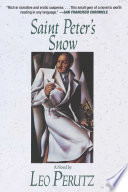
Perutz's early works, such as The Marquis of Bolibar (1920) and The Master of the Day of Judgment (1923), established his reputation for "journalistic fiction"—a style of rapid-paced, document-based storytelling that combined genre elements with surreal complexity, earning admiration from figures like Jorge Luis Borges , Italo Calvino , Graham Greene , and Ian Fleming . Later novels like St. Peter's Snow (1933), The Swedish Cavalier (1936), and Little Apple (1943) delved into prophetic visions of political upheaval and personal displacement, reflecting the encroaching threats to Central European Jewry. His masterpiece, By Night Under the Stone Bridge (1953), weaves a fantastical tale of Rabbi Löw and Emperor Rudolf II in Renaissance Prague , showcasing his mastery of historical irony and the uncanny.
The Nazi Anschluss in 1938 forced Perutz to flee Vienna via Italy to Palestine , where he resumed work as an actuary and continued writing amid personal and professional hardships. He returned to Austria in 1950, settling in Bad Ischl , where he died on August 25, 1957. Though his post-emigration output received less acclaim, Perutz's oeuvre remains a vital chronicle of the Austro-Hungarian Empire's collapse and the perils of totalitarianism , preserved in his digitized literary estate at the German National Library , which includes manuscripts, diaries, and unpublished works.
Leo Perutz was born on November 2, 1882, in Prague , then the capital of Bohemia within the Austro-Hungarian Empire . He was the eldest son in a prosperous Jewish family engaged in the textile trade, with his father, Benedikt Perutz, serving as a cloth merchant, and his mother, Emilie Emma Perutz (née Östreicher), managing the household. The Perutz family traced its roots to Spanish Jews who had settled in the region around the early 18th century, though they maintained a largely non-religious outlook while preserving their cultural heritage.
Perutz shared a familial connection with Nobel Prize-winning molecular biologist Max Ferdinand Perutz, who was his cousin ; the two were linked through their shared Perutz lineage in the Austro-Hungarian Jewish community. Growing up as one of four siblings in this upper-middle-class household, Perutz experienced a childhood immersed in the dynamic, multilingual atmosphere of Prague's German-speaking Jewish quarter. This environment, marked by a blend of German, Czech, and Yiddish influences, was intellectually vibrant and contributed to the cultural flourishing of Jewish intellectuals in the city during the late 19th century .
The Perutz family's engagement with Prague's rich literary scene provided young Leo with early exposure to literature, from family discussions to the broader stimuli of local theaters, cafes, and publishing houses that defined the city's golden age of Jewish culture. This foundational setting nurtured his lifelong interest in storytelling and ideas, even as the family relocated to Vienna in 1899 during his adolescence.
Books by Leo Perutz
Other works by Leo Perutz
More books by this author — not yet covered in our podcast catalog.