Authors & Guests / Lawrence Lessig

Lawrence Lessig
Lawrence Lessig (born 1961) is an American legal scholar and political activist whose work centers on the intersection of law , technology , and democracy . He holds the position of Roy L. Furman Professor of Law and Leadership at Harvard Law School , where he also directs the Edmond J. Safra Center for Ethics, following prior roles at Stanford Law School and the University of Chicago. Lessig earned a BA in economics and BS in management from the University of Pennsylvania , an MA in philosophy from Cambridge University, and a JD from Yale Law School ; he clerked for Judge Richard Posner and Justice Antonin Scalia .
Lessig gained prominence for founding the Center for Internet and Society at Stanford and serving as a founding board member of Creative Commons , which promotes flexible copyright licensing to foster cultural sharing amid digital expansion. His influential books, such as Code and Other Laws of Cyberspace (1999) and Free Culture (2004), argue that software architecture and intellectual property regimes shape online behavior as powerfully as traditional law, critiquing overreach by copyright holders. Shifting focus to institutional corruption , he founded Equal Citizens to advocate citizen-funded elections and rank-choice voting, authoring Republic, Lost (2011) to diagnose money's distorting role in politics . In 2015 , Lessig launched a single-issue Democratic presidential campaign pledging to enact comprehensive reform before resigning, which drew skepticism for its narrow scope and ended in withdrawal after failing to secure debate access, highlighting challenges in prioritizing structural fixes over partisan appeals. He has faced legal disputes, including a successful fair-use defense against music licensing claims and a defamation suit against The New York Times over a misleading headline on his Epstein-related remarks, underscoring tensions between advocacy and media portrayal. Despite academic acclaim and awards like the Free Software Foundation's Freedom Award, Lessig's reform initiatives have yielded limited legislative success, reflecting entrenched interests in U.S. governance.
Lawrence Lessig was born on June 3, 1961, in Rapid City, South Dakota , to Lester Lawrence "Jack" Lessig II, an engineer who owned a steel-fabrication firm, and Patricia Lessig, who sold real estate . In 1963, his family relocated to Williamsport, Pennsylvania , where he spent the remainder of his childhood.
Lessig's early political outlook, initially shaped by his family's environment, shifted toward liberalism in the wake of the Watergate scandal , which unfolded during his pre-teen years, compounded by a formative summer trip that exposed him to broader social dynamics. This period marked the onset of his interest in governance and ethics, though specific mentors from childhood remain undocumented in primary accounts; his father's engineering background may have indirectly fostered an analytical approach to systems, prefiguring Lessig's later interdisciplinary work.
Lessig completed his undergraduate education at the University of Pennsylvania , earning a Bachelor of Arts in economics from the College of Arts and Sciences and a Bachelor of Science in management from the Wharton School in 1983.
He then pursued graduate studies in philosophy at Trinity College, University of Cambridge , where he received a Master of Arts in 1987.
Lessig subsequently enrolled at Yale Law School , obtaining his Juris Doctor in 1989. During his time at Yale, he clerked for Judge Richard Posner on the United States Court of Appeals for the Seventh Circuit and later for Justice Antonin Scalia on the Supreme Court of the United States .
Lawrence Lessig commenced his academic career at the University of Chicago Law School , serving as Assistant Professor of Law from 1991 to 1995 and advancing to Professor of Law from 1995 to 1997.
Books by Lawrence Lessig
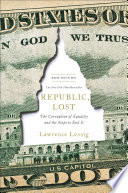
Other works by Lawrence Lessig
More books by this author — not yet covered in our podcast catalog.