Authors & Guests / Larry McMurtry

Larry McMurtry
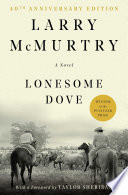
Larry McMurtry (June 3, 1936 – March 25, 2021) was an American novelist , essayist, bookseller, and screenwriter whose works chronicled the fading myths and harsh realities of the American West . Over a career spanning six decades, he produced more than 30 novels, along with screenplays, memoirs, and literary essays, often drawing from his Texas ranching heritage to depict unromanticized frontier life marked by violence, loss, and stoic endurance. His 1985 novel Lonesome Dove , an epic tale of a cattle drive from Texas to Montana led by aging ex-Rangers, earned the Pulitzer Prize for Fiction in 1986 and was adapted into an Emmy-winning television miniseries. Other notable adaptations from his books include the films Hud (1963) and The Last Picture Show (1971), both Oscar-nominated for their screenplay contributions, and Terms of Endearment (1983), which won the Academy Award for Best Adapted Screenplay . Beyond writing, McMurtry amassed one of the largest rare book collections in the U.S., operating Booked Up, an antiquarian bookstore in his hometown of Archer City, Texas , that at its peak spanned multiple buildings with hundreds of thousands of volumes and drew bibliophiles worldwide.
Larry Jeff McMurtry was born on June 3, 1936, in Wichita Falls, Texas , to William Jefferson McMurtry, a rancher, and Hazel Ruth McMurtry. Shortly after his birth, the family relocated to live with his paternal grandparents on their ranch in Archer County, near Archer City, where McMurtry spent his formative years immersed in the daily rigors of cattle ranching. The ranch environment exposed him to the physical demands of rural Texas life, including herding cattle and contending with isolation, which defined the practical, self-reliant ethos of his upbringing.
Family gatherings featured oral narratives drawn from his grandfather's experiences driving cattle along the Chisholm Trail , traditions that embedded a sense of historical continuity and frontier realism in McMurtry's early worldview. These stories, passed down without written records, highlighted the hardships of pioneer ranching, such as unpredictable weather, livestock losses, and interpersonal tensions within extended families dependent on land and labor. The household itself lacked printed materials beyond possibly a Bible , reinforcing a cultural reliance on spoken memory over literacy in this bookless setting.
In 1942, at age six, McMurtry received his initial collection of books—nineteen volumes—gifted by his cousin Gerald, who was enlisting for World War II service; these included adventure tales sent from European battlefields by another relative. With no local library or bookstore accessible in the remote area, he devoured these texts independently, cultivating a solitary reading habit that contrasted sharply with the oral ranch traditions and ignited his lifelong affinity for literature. This sparse introduction to books amid pervasive rural toil fostered a grounded perspective, where imaginative escape intertwined with the causal realities of economic survival and familial duty on the land.
McMurtry enrolled at Rice University in Houston in the fall of 1954 but transferred to North Texas State College (now the University of North Texas ) in Denton after three semesters, completing a B.A. in English in the spring of 1958. He subsequently returned to Rice University , earning an M.A. in English in 1960. That same year, he secured a position as a Wallace Stegner Fellow in the Creative Writing Center at Stanford University for the 1960–1961 academic year, where he honed his craft under Stegner's guidance.
Stegner, who had established Stanford's creative writing program, directed McMurtry toward regional American narratives rooted in verifiable landscapes and histories, rather than abstract modernism or escapist fiction.
Books by Larry McMurtry
Other works by Larry McMurtry
More books by this author — not yet covered in our podcast catalog.