Authors & Guests / Kate Raworth

Kate Raworth
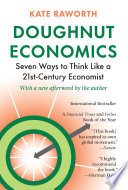
Kate Raworth is a British economist recognized for creating the Doughnut model, a diagram representing the ecologically safe and socially just space for human prosperity between planetary boundaries and basic human needs. She detailed this framework in her 2017 book Doughnut Economics: Seven Ways to Think Like a 21st-Century Economist , which challenges GDP-centric growth models and advocates rethinking economic priorities to address 21st-century ecological and social realities. Raworth serves as a Senior Teaching Fellow at the University of Oxford's Environmental Change Institute, where she instructs on masters-level courses in environmental change and management, and she co-founded the Doughnut Economics Action Lab to promote practical applications of her ideas. While her concepts have informed sustainability initiatives in cities such as Amsterdam and Brussels, they have faced criticism from economists for caricaturing mainstream theory, neglecting market incentives, and offering vague prescriptions without robust empirical backing for alternatives to growth-driven development.
Kate Raworth was born in 1970 to a mother employed as a florist and a father who worked as a businessman. She has one older sibling, her sister Sophie Raworth , a BBC news presenter born on May 15, 1968.
Raworth grew up in west London and attended St Paul's Girls' School, a selective independent institution, where she later served as head girl. During her teenage years, she experienced a period of painful shyness, during which she gained weight, felt acutely self-conscious, and withdrew socially, preferring to spend time reading, playing the saxophone , and pursuing artistic activities. Her relationship with Sophie was strained at the time, marked by frequent arguments and occasional physical fights, though it strengthened significantly in their twenties.
Raworth earned a first-class Bachelor of Arts degree in Politics , Philosophy, and Economics from the University of Oxford . This undergraduate program emphasizes interdisciplinary analysis of political systems, ethical theory, and economic principles. Following her BA, she pursued graduate studies at the same institution, obtaining a Master of Science in Economics for Development, which focuses on applying economic tools to issues of poverty , inequality, and sustainable growth in developing contexts.
In recognition of her scholarly and practical contributions to economics, Raworth has been awarded multiple honorary doctorates, including from Business School Lausanne, University College Dublin in 2024, KU Leuven , and the University of York . These honors reflect institutions' acknowledgment of her influence beyond formal academia, though she holds no doctoral degree from her own studies.
Following her undergraduate studies at Oxford University, Raworth served as a fellow of the Overseas Development Institute from 1994 to 1997, during which she spent three years promoting micro-enterprise development in villages across Zanzibar , Tanzania . In this role, she collaborated with local "barefoot entrepreneurs" to foster small-scale economic activities amid challenging development contexts.
Subsequently, Raworth relocated to New York to work as an economist and co-author for the United Nations Development Programme's (UNDP) annual Human Development Report over four years, approximately from 1997 to 2001. She contributed to key chapters, including analyses of new technologies and global knowledge disparities in the 1999 and 2000 editions.
In 2002, Raworth joined Oxfam as a researcher, advancing to senior researcher by focusing on issues such as the exploitation of women in global supply chains and broader campaigns for human rights and poverty alleviation. Her work at Oxfam during this initial phase emphasized empirical assessments of development inequalities, laying groundwork for later explorations into sustainable economic models.
Books by Kate Raworth
Other works by Kate Raworth
More books by this author — not yet covered in our podcast catalog.