Authors & Guests / Jonathan Haidt

Jonathan Haidt
Jonathan Haidt is an American social psychologist renowned for his empirical research on the intuitive foundations of morality and their implications for political division and cultural differences. He developed Moral Foundations Theory , which identifies key innate moral intuitions—such as care/harm, fairness/cheating, loyalty/betrayal, authority/subversion, sanctity/degradation, and liberty/oppression—that underpin ethical judgments and explain why liberals and conservatives prioritize distinct values. Haidt's work emphasizes that moral reasoning often serves as post-hoc rationalization for rapid, emotion-driven intuitions, challenging rationalist models in psychology .
As the Thomas Cooley Professor of Ethical Leadership at New York University Stern School of Business, Haidt has held academic positions including sixteen years in the Psychology Department at the University of Virginia and previously earned a B.A. in philosophy from Yale University and a Ph.D. in psychology from the University of Pennsylvania . His influential books, including The Happiness Hypothesis (2006), The Righteous Mind: Why Good People Are Divided by Politics and Religion (2012, a New York Times bestseller), and The Coddling of the American Mind (2018, co-authored with Greg Lukianoff , also a New York Times bestseller), apply moral psychology to contemporary issues like polarization and the fragility of young minds in overprotected environments. In The Anxious Generation (2024), he presents data linking the shift to smartphone-based childhoods with surging mental health problems among adolescents, advocating for delayed exposure to social media and increased free play.
Haidt co-founded Heterodox Academy in 2015 to foster open inquiry and viewpoint diversity amid growing ideological conformity in higher education, drawing on surveys revealing disproportionate left-leaning faculty representation that correlates with self-censorship among students and professors. His critiques of "safetyism"—the prioritization of emotional safety over resilience—and institutional biases have sparked debates, positioning him as a proponent of evidence-based reforms to counteract what he identifies as causal factors in declining academic freedom and youth well-being, grounded in cross-cultural and experimental data rather than ideological priors.
Jonathan Haidt was born in 1963 in New York City to a secular Jewish family. He was raised in Scarsdale, New York , a suburb north of the city, where his grandparents had immigrated from Russia and Poland .
Haidt earned a Bachelor of Arts degree in philosophy from Yale University in 1985. He then pursued graduate studies in psychology , receiving his Ph.D. from the University of Pennsylvania in 1992.
Haidt earned a Bachelor of Arts degree in philosophy from Yale University in 1985, graduating magna cum laude. He then pursued graduate studies in psychology at the University of Pennsylvania , obtaining a Master of Arts in 1988 and a Ph.D. in 1992, with a dissertation titled "Moral judgment, affect, and culture , or, is it wrong to eat your dog?"
Following his doctorate, Haidt held postdoctoral positions, including a fellowship in the University of Chicago's Committee on Human Development under an NIMH training program from July 1992 to June 1994, and a postdoctoral associate role with the John D. and Catherine T. MacArthur Foundation from July 1994 to August 1995. He joined the University of Virginia's Department of Psychology as an assistant professor in August 1995, advancing to associate professor in August 2001 and full professor in August 2009, where he remained until May 2012. During this period at Virginia, Haidt directed the Positive Psychology Summer Institute from 2002 to 2005. He also served as Laurence S.
Books by Jonathan Haidt

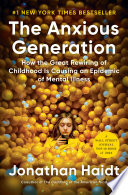
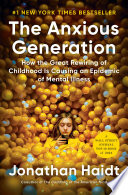
Other works by Jonathan Haidt
More books by this author — not yet covered in our podcast catalog.