Authors & Guests / Ed Catmull

Ed Catmull
Edwin Earl Catmull (born March 31, 1945) is an American computer scientist and executive recognized for foundational advancements in three-dimensional computer graphics that enabled modern digital animation and visual effects. His innovations, including z-buffering for hidden surface removal, texture mapping for applying surface details, subdivision surfaces for modeling smooth curves, and efficient rendering of bicubic patches, originated from his doctoral research and early professional work. Catmull shared the 2019 ACM Turing Award with Pat Hanrahan for these contributions and their profound influence on computer-generated imagery in film.
Catmull earned bachelor's degrees in physics and computer science from the University of Utah in 1969, followed by a PhD in computer science there in 1974, during which he produced the first rendering of a three-dimensional polygon film sequence. He directed computer graphics laboratories at the New York Institute of Technology and Lucasfilm before co-founding Pixar Animation Studios in 1986 as an independent entity spun off from Lucasfilm. Under his technical and executive leadership as president and chief technology officer, Pixar developed proprietary software like RenderMan and produced the world's first fully computer-animated feature film, Toy Story , in 1995.
Following Disney's acquisition of Pixar in 2006, Catmull extended his role to president of Walt Disney Animation Studios , revitalizing its creative output with films such as Ratatouille (2007), Up (2009), and Frozen (2013), while maintaining Pixar 's dominance in animation innovation. He retired from these positions in 2019 after over three decades shaping the intersection of computing and storytelling in cinema.
Edwin Catmull was born on March 31, 1945, in Parkersburg, West Virginia , amid World War II , as his father served as a Marine in the Pacific theater, including the Battle of Iwo Jima , after meeting his mother in San Francisco . The family relocated to Salt Lake City, Utah , when Catmull was two years old, where his father advanced in education as a high school mathematics teacher and principal, earning a doctorate , while his mother served as an elementary school assistant; the household, shared with four siblings, emphasized academic discipline .
During the 1950s, Catmull's imagination was captured by Walt Disney animated films, particularly Pinocchio (1940) and Peter Pan (1953), viewed on television shows like The Wonderful World of Disney , fostering a deep aspiration to work as a feature film animator at the studio. He pursued this dream through early experiments, filling sketchbooks with drawings and crafting flipbooks to mimic motion, though these efforts highlighted the challenges of hand-drawn techniques.
Catmull enrolled in extensive art classes during high school, even representing Utah in a national art scholarship competition , yet he discerned his insufficient proficiency in freehand drawing for professional animation standards. This realization prompted an early intuition that emerging technologies, such as computers, could provide the mathematical precision needed to overcome the inconsistencies of manual artistry and realize flawless animated visions.
Catmull enrolled at the University of Utah in 1963, initially pursuing studies in physics before incorporating computer science coursework amid the emergence of graphics research. He completed Bachelor of Science degrees in both physics and computer science in 1970, benefiting from the university's pioneering computer graphics laboratory established by David Evans and influenced by Ivan Sutherland's methodologies. This environment, characterized by ARPA-funded projects emphasizing exploratory computation over rigid constraints, cultivated Catmull's approach to algorithmic problem-solving grounded in geometric primitives and visibility computations.
Books by Ed Catmull
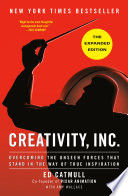
Other works by Ed Catmull
More books by this author — not yet covered in our podcast catalog.