Authors & Guests / Chris Hedges
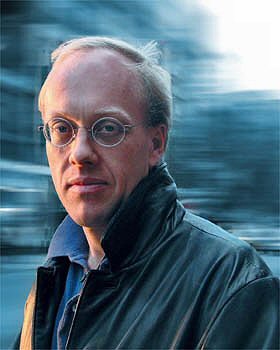
Chris Hedges
Christopher Lynn Hedges (born September 18, 1956) is an American journalist , author , ordained Presbyterian minister, and activist.
Hedges began his career as a freelance journalist and served as bureau chief for The Dallas Morning News in Central America and the Middle East before joining The New York Times in 1990, where he covered major conflicts including the Gulf War and the Balkans until 2003. He contributed to the Times team's Pulitzer Prize for Explanatory Reporting in 2002 for coverage of global terrorism.
As an author of over a dozen books, Hedges has critiqued the psychological and societal effects of war, American imperialism , and corporate dominance, with works such as War Is a Force That Gives Us Meaning (2002) and Days of Destruction, Days of Revolt (2012). His activism encompasses protests against economic inequality , including his arrest during an Occupy Wall Street demonstration outside Goldman Sachs in 2011, and a successful lawsuit challenging indefinite detention under the National Defense Authorization Act . Hedges' opposition to U.S. military interventions, notably voiced in a 2003 commencement address criticizing the Iraq War , contributed to his departure from The New York Times .
Christopher Lynn Hedges was born on September 18, 1956, in St. Johnsbury, Vermont. His father, a World War II veteran who served as a tank commander in the U.S. Army, later became a Presbyterian minister in Schoharie, a rural farming community in upstate New York, where Hedges spent much of his childhood. The elder Hedges, known for his anti-war activism, pastored a small congregation in this isolated area, emphasizing moral and ethical teachings rooted in Presbyterian doctrine.
Hedges' mother worked initially as a schoolteacher before advancing to become an English professor , providing an intellectual environment amid the family's modest, rural circumstances. The household reflected a blend of religious piety and academic rigor, with the father's ministerial duties involving community service and sermons on social justice themes, while the mother's career focused on literature and education . This upbringing in a working-class, faith-oriented setting in Schoharie—characterized by agricultural labor and limited urban influences—shaped Hedges' early exposure to themes of hardship, ethics, and dissent against authority.
Hedges received a Bachelor of Arts degree in English literature from Colgate University in 1979. At Colgate, he was significantly influenced by the Reverend Coleman Brown, a professor whose teachings on human rights , ethics , and personal integrity shaped Hedges' worldview; Hedges later described Brown as having instilled in him a commitment to confronting injustice through moral clarity and intellectual rigor. Following his undergraduate studies, Hedges spent time in South America and served briefly as a pastor in a small New England church before advancing to graduate education .
In 1983, Hedges earned a Master of Divinity from Harvard Divinity School , where his coursework emphasized theological and ethical traditions, including exposure to figures like Rudolf Bultmann , whose demythologizing approach to scripture, informed by existential phenomenology , resonated in Hedges' later critiques of literalist interpretations in both religious and secular ideologies. Key mentorship came from James Luther Adams, a theologian known for his emphasis on voluntary associations, social ethics, and resistance to totalitarianism , which aligned with Hedges' developing interest in the interplay of faith, power, and justice. This period deepened his engagement with Christian realism and liberation theology , frameworks that would inform his journalistic emphasis on systemic critique over individualistic piety.
Books by Chris Hedges
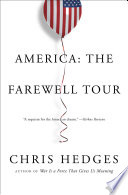
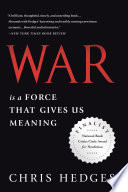
Other works by Chris Hedges
More books by this author — not yet covered in our podcast catalog.