Authors & Guests / Carl Sagan

Carl Sagan
Carl Edward Sagan (November 9, 1934 – December 20, 1996) was an American astronomer, planetary scientist, cosmologist, astrophysicist, astrobiologist, and author renowned for advancing exobiology and popularizing scientific inquiry through works like the television series Cosmos and books including The Dragons of Eden , which earned a Pulitzer Prize. As a professor of astronomy at Cornell University, he directed the Laboratory for Planetary Studies and advised NASA on missions such as Mariner, Viking, and Voyager, contributing to understandings of planetary atmospheres and potential extraterrestrial life. Sagan pioneered efforts in the search for extraterrestrial intelligence (SETI) and co-designed the Voyager Golden Record, a message from humanity launched into space in 1977. He advocated rigorous skepticism against pseudoscience and emphasized empirical evidence in assessing claims, including UFO phenomena, while critiquing overreliance on authority in scientific institutions. Despite his public acclaim, Sagan faced criticism from peers for prioritizing media outreach over traditional research output, exemplified by his 1992 rejection from the National Academy of Sciences amid debates over his scientific rigor. His work on nuclear winter scenarios in the 1980s, warning of global climatic catastrophe from nuclear war, drew both praise for raising awareness and scrutiny for potentially exaggerating effects based on models later refined.
Carl Edward Sagan was born on November 9, 1934, in Brooklyn , New York, into a working-class Jewish family . His father, Samuel Sagan (1905–1979), had immigrated to the United States from Ukraine as a child and worked as a garment worker or factory manager in the immigrant community. His mother, Rachel Molly Gruber Sagan (1906–1982), was a homemaker whose family originated from the Austro-Hungarian Empire ; she was known for her vivacious personality and strong devotion to her son. The family included Sagan's sister, Carol, and they resided initially in Brooklyn's Bensonhurst neighborhood before relocating to Rahway, New Jersey , where Sagan attended public schools and graduated from Rahway High School in 1951.
Sagan's parents significantly shaped his early worldview and intellectual curiosity . Samuel Sagan, drawing from his own experiences as an immigrant from Russia , emphasized optimism, human decency, and the potential for progress, recounting tales of his European travels that instilled a sense of wonder in young Carl. Rachel Sagan supported her son's pursuits by providing resources like chemistry sets and encouraging reading, though the family's modest means limited formal opportunities. This parental encouragement fostered Sagan's self-directed exploration of science fiction and popular astronomy texts from local libraries, where by age nine he developed a fascination with stars and extraterrestrial possibilities.
A pivotal childhood experience occurred around age four, when Sagan's parents took him to the 1939 New York World's Fair , exposing him to exhibits on technology, skyscrapers, and space that sparked his enduring interest in scientific discovery and the cosmos . These family influences—rooted in immigrant resilience, storytelling , and active support for inquiry —laid the foundation for Sagan's later emphasis on empirical skepticism and the humanistic value of science , distinct from the religious elements present in his mother's background that he ultimately rejected in favor of rationalism .
Sagan developed an early fascination with astronomy and science during childhood, inspired by science fiction literature and the realization, prompted by a librarian , that the Sun is itself a star. This curiosity extended to conducting rudimentary experiments, such as attempts to detect life on Mars using basic equipment.
Books by Carl Sagan
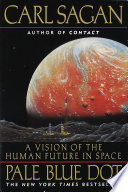
Other works by Carl Sagan
More books by this author — not yet covered in our podcast catalog.