Authors & Guests / Arthur C. Clarke
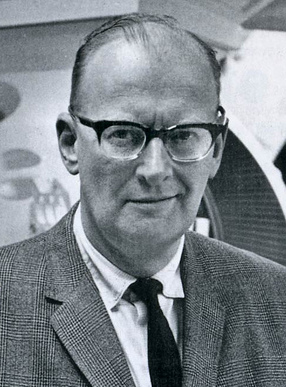
Arthur C. Clarke
Sir Arthur Charles Clarke (16 December 1917 – 19 March 2008) was an English science fiction author, futurist, inventor, and undersea explorer whose prescient ideas and imaginative storytelling profoundly influenced perceptions of space exploration and technology.
Born in Minehead, Somerset, to a farming family, Clarke developed an early fascination with science and astronomy, joining the British Interplanetary Society in 1936 while working as an auditor. During World War II, he served in the Royal Air Force as a radar instructor and technician, contributing to the development of ground-controlled approach systems for aircraft landings. After the war, he earned a degree in physics and mathematics from King's College London and began publishing science fiction short stories and technical papers.
In 1945, Clarke published "Extra-Terrestrial Relays: Can Rocket Stations Give World-wide Radio Coverage?", outlining the use of geostationary satellites for global communications—a concept realized decades later and now known as the Clarke Orbit . His literary career flourished with over 100 works, including seminal novels like Childhood's End (1953), Rendezvous with Rama (1973), and The Fountains of Paradise (1979), the latter two earning both Hugo and Nebula Awards. Clarke's collaboration with director Stanley Kubrick produced the 1968 film 2001: A Space Odyssey , adapting his short story "The Sentinel" into a landmark exploration of human evolution, artificial intelligence, and extraterrestrial contact.
Relocating to Sri Lanka in 1956 for scuba diving and underwater exploration, Clarke founded a diving company and conducted marine research, while continuing to advocate for space travel and scientific advancement. Knighted in 1998 for services to literature and awarded Sri Lankabhimanya in 2005, he received numerous honors including multiple Hugo Awards and a Nebula Grand Master designation, though later years were marked by health challenges from polio contracted in 1962. Clarke's optimistic vision of humanity's technological destiny, grounded in rigorous scientific extrapolation, earned him recognition as one of the 20th century's most influential thinkers.
Arthur Charles Clarke was born on 16 December 1917 in Minehead , a coastal town in Somerset , England, to Charles Wright Clarke, a farmer, and Mary Nora Jessie Willis Clarke. He was the eldest of four children; his siblings included brothers Frederick William (born 1921) and Michael Heal Clarke, and sister Nora Mary Clarke.
The Clarke family resided in a rural farming household near Minehead, where young Arthur spent his early years in a modest environment typical of early 20th-century English provincial life. His father managed local agricultural interests, providing a stable but unremarkable backdrop that contrasted with Clarke's emerging fascination with the cosmos; as a child, he frequently engaged in stargazing, fostering an early curiosity about astronomy and the night sky.
This period was disrupted in May 1931 when his father died, leaving Clarke, then aged 13, to navigate family responsibilities alongside his mother, who outlived him until 1980. The loss marked a pivotal shift, compelling greater self-reliance in a household now headed by his widowed mother, though the family's agrarian roots continued to shape Clarke's grounded perspective amid his growing intellectual pursuits.
Clarke attended Huish's Grammar School in Taunton from 1927 until 1936, when financial difficulties following his father's death in 1930 forced him to leave without completing further formal studies. As a child on his family's farm in Somerset, he developed an early fascination with science around age six, constructing his first telescope from cardboard tubes and engaging in stargazing and fossil collecting. He avidly read American science fiction magazines and works by authors such as H.G. Wells and Jules Verne , which ignited his enduring interest in space exploration and futurism.
Books by Arthur C. Clarke
Other works by Arthur C. Clarke
More books by this author — not yet covered in our podcast catalog.